

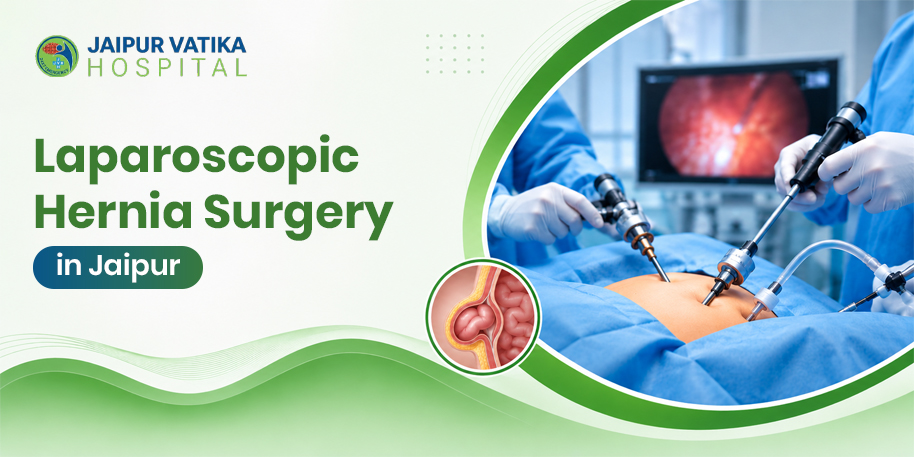
A complete guide to how hernia surgery works, how long it takes to recover and what laparoscopic hernia treatment costs in Jaipur. If you are living in Jaipur and suffering from hernia and the doctor has suggested laparoscopic hernia surgery to you, this guide is just for you.
What Is Hernia?
You start seeing a small bulge in your stomach or your inguinal area, and it starts showing up every time you cough, sneeze, lift a bag of groceries, or anything heavy, or stand up too fast. This happens because the muscles and tissues in the area become weak or damaged. When a doctor and get diagnosed with hernia, the doctor recommends laparoscopic hernia surgery and you start wondering if it is really needed or can be avoided? Let's understand what laparoscopic hernia surgery is and how it can benefit you.
What Is Laparoscopic Hernia Surgery?
Laparoscopic hernia surgery is a keyhole procedure (also known as a minimally invasive procedure) that fixes a hernia by using a few tiny cuts rather than an open incision. Instead of large incisions, the surgeon uses a camera and special instruments to repair the hernia. The surgeon is able to see the inside of the abdomen on a monitor and place a surgical mesh to permanently seal the weak area in the abdominal wall.
The Reason Why Hernia Occurs?
A hernia occurs when part of the abdominal muscle wall weakens and an internal organ or fatty tissue forces through it. When this occurs in the groin, it is called inguinal hernia, umbilical hernia when it occurs in the region of the belly button. Incisional hernia occurs at the place of old surgery scar.
What Makes Hernia Surgery Necessary?
A hernia doesn't heal on its own and if left untreated it can grow larger. In many cases the bulging tissue gets trapped and out of limb blood supply and when this happens it gives rise to a complication called strangulation, which calls for emergency surgery.
The sooner a hernia is treated, the easier the treatment becomes with better outcomes.
How Does Laparoscopic Hernia Surgery Work?
Here is a step-by-step guide about how a laparoscopic hernia surgery works:
- Anesthesia: The patient is given general anesthesia, to make the patient fully asleep and unconscious during the procedure.
- Small Incisions: The surgeon makes three or four cuts, each under a centimeter long, compared to a long cut as seen in traditional surgery.
- Camera and Instrument Insertion: A laparoscope which has a thin tube with a camera is inserted through one of the tiny incisions, giving the surgeon an enlarged perspective of the hernia on a screen.
- Mesh Placement: The surgeon pushes the bulging tissue back into place and puts a surgical mesh over the weak spot to strengthen the abdominal wall.
- Closure: The small incisions made initially are then closed with stitches.
How Long Does Laparoscopic Hernia Surgery Take?
Usually a single and simple laparoscopic hernia surgery takes 30 to 60 minutes. If the hernia is large and complicated, the operation can take 90 minutes. If anesthesia preparation and recovery monitoring may take an extra few hours but most patients are discharged on the same day after the surgery.
Choosing Between Laparoscopic Hernia Surgery and Open Surgery for Hernia
In open surgery, a single long incision is done over the site of hernia whereas laparoscopic surgery is done through several small incisions. Here is a table to give you a better idea:
| What You'll Notice | Laparoscopic | Open Surgery |
|---|---|---|
| Incision size | 3-4 small cuts (under 1 cm each) | One larger cut (several cm) |
| Scarring | Minimal, often barely visible later | More visible scar |
| Pain after surgery | Generally lower | Generally higher |
| Hospital stay | Same day to overnight | Often 2-3 days |
| Return to light activity | About 1 week | 2-3 weeks or more |
| Return to normal routine | 2-3 weeks | 4-8 weeks |
Laparoscopic surgery isn't always the right choice especially when it comes to very large hernias, incisional hernias and complicated or strangulated hernias. Open surgery is suitable in certain cases where the treatment of choice. Each case is different and the decision about the kind of surgery required is made after assessment of hernia CT imaging is often used for proper diagnosis and treatment planning.
Recovery After Laparoscopic Hernia Surgery
Recovery time decides when a patient gets back to routine life. Here is an average time span of recovery in most cases.
This is always the patient's biggest concern and for a good reason - recovery time is the one that determines when you're back at work, back to driving and picking up your kids.
Days 1-3: Slight tenderness around the incision site is common. By the time patients leave the hospital, most can walk a short distance and pain is controlled with the prescribed pain medication. Never lift more than a kilo.
Week 1: Light activities such as walking, light household work and desk work are generally OK during week 1. Patients are also to return to their doctor by day 5-7.
Weeks 2-3: Majority return to normal work, including desk jobs requiring some walking and standing. This is also when laparoscopic hernia surgery recovery time starts to become fast compared to open surgery, as open surgery patients in second and third week are still limited in their activities.
Weeks 3 to 4: Slowly return to exercise, driving greater distances and more physical hobbies, under the supervision of your surgeon's examination.
After week 6: Resume heavy lifting, exercise and manual work as per surgeon's approval when the repair is fully set.
Recovery after laparoscopic hernia surgery depends on the size of the hernia, your age, your fitness level, and if it is a first-time hernia repair versus a recurrent hernia repair. Patients who adhere to the post-op guidelines, walk regularly but not too much, and avoid heavy lifting, tend to have the most dependable and the fastest recovery time.
Cost of Laparoscopic Hernia Surgery
Most patients are worried about the laparoscopic hernia surgery cost. There's no way to give a precise price without evaluation and diagnosis by professionals as there are a number of factors that influence the cost of the surgery:
- Size and type of the hernia: A small umbilical hernia would be handled differently to a large inguinal hernia that has existed for many years.
- Surgical technique: Single-incision repair or robotic-assisted repair.
- Cost of the mesh: The type of mesh material will have different costs.
- Length of stay in hospital: One day discharge, or overnight or longer.
- Diagnostic tests and anesthetic fees: Tests and type of anesthesia that will be needed prior to surgery for your case.
- Coverage under insurance policy: Many health insurance policies in India cover hernia surgery, drastically reducing the out-of-pocket cost.
For costing treatment and insurance it is always better to check with the hospital if you can cover the cost of hernia surgery with your policy.
Conclusion
A hernia will not get better on its own. Delaying or avoiding treatment will make the case more complicated and a tenth problem. Laparoscopic hernia surgery reduces pain, small cuts, same day or overnight hospital stay and a quicker return to normal activities compared to open surgery, which generally returns patients to light activity within a week and full routine within 3-6 weeks.
The exact details of surgery length, cost and your individual recovery time will vary depending on your hernia and your health, and that's not something that should be estimated. If you have been suffering from such a bulge for quite a long time, discuss it with a surgeon experienced in laparoscopic repair to see what is best for you personally.
If you have any more questions about your hernia, schedule an appointment with a laparoscopic surgeon in Jaipur at Jaipur Vatsalya Hospital to discuss your treatment options and receive a true and unbiased evaluation of your case.
faq.faqs
faq.faqs-subheading
The first 2-3 days are typically mildly uncomfortable and well controlled with prescribed pain medication. The incisions are quite small and so there is generally less pain than with the open surgery. Open and most people are not taking powerful painkillers within a few days of the surgery.
Appropriate mesh reinforcement is a surgical repair makes recurrence very rare, with most studies reporting less than 5%. The risks are also higher if you lift things too soon after surgery, are obese, smoke or have chronic coughing, which puts strain on the repair before it can heal.
If you're not driving yourself, light desk jobs generally are okay for two days. Longer trips, such as trips by car,are generally recommended only after the first follow-up visit, when incisions are seen to be healing well (about 1 to 2 weeks).
Yes, laparoscopy hernia surgery is under general anaesthesia and the patient will be asleep for the whole procedure.The anaesthesia team will examine your medical history before the surgery takes place to be sure about patientsafety.
The untreated hernia will enlarge and become more uncomfortable with time and will go away spontaneously. Sometimest issue becomes trapped and deprived of blood circulation, causing a planned surgery to become an emergency surgery,hence the importance of timely evaluation.