

If getting out of bed in the morning, climbing stairs or sitting on the floor for family meals seems like a struggle, it's not easy.If it is difficult to get out of bed in the morning and climb stairs, or sitting on the floor to enjoy family meals, it is not easy. But for millions of adults, each step is accompanied by a familiar ache, click or sharp thrum in the knees. Early stiffness is often attributed to "old age.Early stiffness is a familiar phenomenon and is frequently overlooked as "part of getting older. But the reality is that ongoing knee pain is never something that one just has to put up with. If you are experiencing knee pain in adults, whether it's a sudden spurt from a painful turn or a niggling, grinding sensation that's been present for months, it's crucial to grasp the root causes of knee pain in adults before you begin working to regain pain-free, smooth motion. Your knee is one of the joints in your body that is put to the most use, taking up to four times your body weight with each step you take. If something goes wrong within that joint, timely and accurate knee pain treatment in Jaipur can preserve mobility, prevent the permanent wearing of the joint and help you stay active. This guide explains the function of your knee joint, why it is painful, what to look out for and when you may need to see an orthopedic doctor in Jaipur, and all the modern knee pain treatment options you have today.
Quick Takeaways
The Knee is a Natural Shock Absorber: Your knee puts weight on smoothly with the help of smooth cartilage, strong ligaments, and rubbery cushioning pads.
Find the source of the pain: Knee pain may arise from sudden injury , slow wear and tear or metabolic causes.
Early Care Prevents Surgery: Many knee conditions can be successfully treated without surgery, by using targeted physiotherapy, lifestyle changes and modern joint therapies.
If there are Critical Red Flags like inability to bear weight, sudden fever with a hot joint or knee that will physically "lock" in place, immediate care from the knee pain doctor in Jaipur is required.
Personalized Modern Solutions: Today's treatment includes such options as hyaluronic acid lubricating injections, Platelet-Rich Plasma therapy and minimally invasive robotic joint replacement, all tailored to your lifestyle and age.
How Your Knee Works: A Simplified Guide.
To get a good understanding of why your knee hurts, it is important to visualize the structure of the knee. Imagine you were a hinge on a heavy door in a building and that the door is heavy.Suppose your knee was a heavy door hinge in a building and the door was heavy.
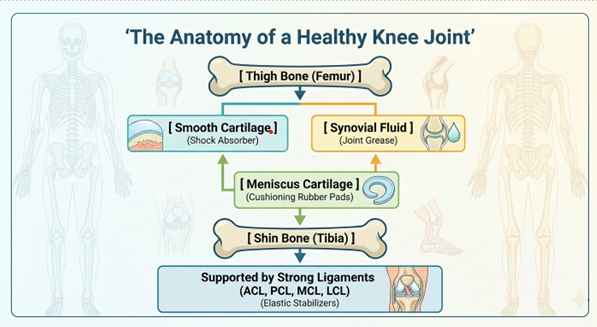
The following is a list of the five main parts of your knee joint that work together:
- Bones: The joint is made up of three bones: thigh bone, shin bone, and kneecap.
- Cartilage: Ends of these bones are covered with a soft rubbery material that makes them move slidingly without friction.
- Menisci: Two cartilage pads in a crescent shape lie between the bones acting as shock absorbing gaskets that evenly distribute body weight.
- Ligaments and Tendons: Strong, elastic bands connect bones together and link muscles to bones, stabilising the joint when the bones are moving.
- Synovial Fluid: When a synovial fluid lubricates this whole joint, it functions like clean engine oil, allowing the joint to move smoothly and without problems.
If any of these parts wear, become inflamed or torn, your knee will no longer roll smoothly and therefore you will experience pain, stiffness and instability.
Common Causes Of Knee Pain In Adults Exist.
When the knee hurts, it usually has a definite cause. The orthopedic doctors classify the causes of knee pain in adults into three broad categories:
What Is Causing Your Knee Pain?
Osteoarthritis:
In adults aged 40 years and above, the most common cause of chronic knee pain is osteoarthritis. The cartilage that covers the ends of the bones slowly breaks down over many years, with use.
As the cartilage wears away the space between the joint narrows. As it gets worse, the bone rips against the bone.
How it feels: A dull, deep ache; increases with prolonged walking or standing; stiffness in the joint in the morning that lasts for 15 to 30 minutes; a grating or “crunching” sound when bending the joint.
Meniscus Tears
Athletes tend to tear a meniscus during their sport, but adults 35 years or older may tear a meniscus during everyday activities, like getting out of a car or squatting. As the meniscus gets older, it will lose elasticity and become more susceptible to fraying.
How it feels: Sharp pain on the inside or outside of the knee, swelling that gradually worsens over 24-48 hours, catching or a lack of full straightening.
Ligaments Tears
The knee is held in place from wobbling or sliding out of alignment by tough structural bands known as ligaments. These fibers can be stretched or torn as a result of an awkward twist or sudden stop in the recreational sport or during a road accident.
How it feels: Sharp "pop" at the time of injury, swelling in just a few hours, extreme pain, and a sense of instability in the knee that it wants to give way beneath you.
Runner's knee
This is when there is friction under the kneecap in the groove as it does not slide smoothly. It is a very common occurrence among desk workers, commuters and people who suddenly increase their level of exercise.
How it feels: A dull, steady aching that comes and goes during walking down stairs, squatting, or sitting for long periods with knees bent.
Gout
Gout occurs when the uric acid accumulates in the joint capsule as tiny crystals of uric acid in the shape of needles. It often begins in the big toe, but it often flares up in the sizable joints of the knees in adults.
The sensation is sudden and often acute, and is associated with intense swelling, shiny red skin and extreme warmth. A light bed sheet that brushes against the knee would cause some discomfort.
Tendinitis and Bursitis
Tendonitis: inflammation of the thick cord that attaches the kneecap to the shin bone, commonly caused by overuse, such as repeated stair climbing or jumping.
Bursitis: Swelling of the tiny fluid sacs (bursae) that cushion pressure points. Swelling over the kneecap may occur if the knee surface becomes soft and squashy from kneeling on hard surfaces.
The American Academy of Orthopaedic Surgeons provides clinical overviews on bone and joint health that are a good source of information about orthopedic conditions.
When Is Knee Pain an Emergency? Red Flag Symptoms
Although most knee problems occur over time and can be assessed in an office exam, there are some indications that require urgent attention in an orthopedic hospital in Jaipur.
Triage Guide for Knee Discomfort:
| Care Level | Symptoms / Signs | Recommended Action |
|---|---|---|
| Mild / Self-Care | Mild stiffness after walking, no swelling, full movement | Rest, apply ice, do gentle stretches, and monitor for 5 to 7 days. |
| Outpatient Clinic | Pain lasting more than 2 weeks, painful clicking, or morning stiffness | Book an appointment with an orthopedic doctor. |
| Emergency Warning | Unable to bear weight, joint is hot and intensely red, or visible deformity | Seek immediate evaluation at a 24/7 orthopedic emergency center. |
Critical Warning Indicators
If you notice any of the following, look for medical help right away:
Complete Inability to Bear Weight: The knee cannot stand on the leg, or two steps on the leg is painful or wobbles.
Septic arthritis can present with chills and fever and a rapidly swollen knee that is very painful, and is a medical emergency requiring antibiotic treatment and drainage of the joint.
A "Locked" Knee: The knee joint becomes stuck in a flexed position that it's not physically able to straighten and may only be flexed manually.
Visible Deformity: The knee appears crooked, bent at an abnormal angle or the kneecap is out of place after a fall.
Numbness or Coldness in the Foot: Pins and needles, paleness or numbness below the knee, which can be a sign of nerve or vascular compression.
Clinical Symptom Checker Table
| Symptom Pattern | Most Likely Cause | Best Course of Action |
|---|---|---|
| Morning stiffness, grinding sensation, worse by evening | Early to moderate Osteoarthritis | Consult an orthopedic doctor in Jaipur for digital X-rays and targeted physical therapy. |
| Sudden "pop" during activity, rapid swelling, instability | Ligament tear or Meniscus tear | Rest, apply cold packs, avoid putting weight on the leg, and get an MRI. |
| Hot, red, swollen knee with sudden severe pain | Gout flare or acute joint inflammation | Immediate blood testing and medical management. |
| Pain behind kneecap when walking down stairs | Patellofemoral Syndrome / Tendonitis | Physiotherapy, quad strengthening, and posture correction. |
| Severe deformity, unbearable pain, fever, zero weight bearing | Fracture, dislocation, or joint infection | Go to an emergency orthopedic center immediately. |
The Full Range Of Knee Pain Treatment Options
The modern approach to orthopedics is a stepped ladder approach, where conservative, non-invasive treatments are used first and subsequently interventional or surgical treatment is initiated if needed.
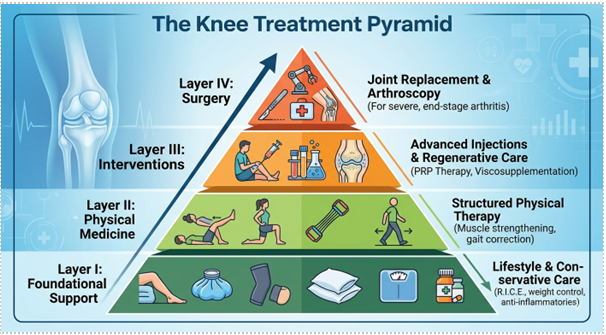
Care and Home Management – Foundation Phase
However, for minor strains, early cartilage thinning, or temporary flare-ups, the simple measures taken throughout the day make a significant difference:
romote natural circulation, prop leg up on pillow when resting.
- Weight Management: Each additional kg of body weight creates an additional 3-4 kg of mechanical stress on your knees with every step. Even a 5% loss of excess weight can reduce the stress on the joints by up to 30%.
- Anti-Inflammatory Nutrition: Ginger, turmeric, walnuts, flaxseeds and leafy greens help to reduce the systemic inflammation naturally.
Structured Physiotherapy and Muscle Strengthening
Muscles around the knee joint help it to stay stable. Strong thigh muscles, back leg muscle and hip muscle take the brunt of the shock of walking and lessen the direct impact on the joint cartilage.
This stabilizes and provides 50%+ pressure relief to the cartilage and absorbs the impact with the help of strong thigh and hip muscles.
Some exercises that will have a low impact are:
- Straight Leg Raises: Strengthens quads without the bending and tension of the knee.
- Hamstring Curls: Equalizes the support of the muscles at the back of the joint.
- Bridging Exercises: Strengthens gluteal muscles with walking posture exercises to improve your walking posture.
- Low Impact Exercise: Stationary cycling and swimming offer excellent exercise with little joint stress.
Phase 3: Advanced Non-Surgical interventions
If exercises are not enough, a knee pain doctor in Jaipur can suggest clinical treatments which can be done without surgery:
Hyaluronic Acid Injections: Hyaluronic acid is a medical-grade lubricant that can be injected into the joint space, creating a smoother surface, which helps to decrease friction and pain for months.
Platelet-Rich Plasma Therapy: This procedure involves taking a small amount of your blood, extracting the natural growth factors and healing platelets, then injecting them into your joint. The National Institute of Arthritis and Musculoskeletal and Skin Diseases (NIAMS) have found evidence that PRP can reduce inflammation and promote soft-tissue healing in early arthritis.
Corticosteroid Injections: If the swelling is severe and painful and walking is difficult, a focused cortisone injection can immediately ease the intense inflammation for a few weeks.
Phase 4: Surgical Solutions
If cartilage has completely broken down in the joints and normal activities of life are being restricted by pain, surgical options are available which can restore your mobility.
Surgical Options Overview
| Minimally Invasive Arthroscopy | A keyhole procedure using a camera to repair torn cartilage or reconstruct the ACL | Certain cartilage, meniscus, or ligament injuries |
| Partial Knee Replacement | Replaces only the damaged compartment of the knee | Damage limited to one part of the knee |
| Total Knee Replacement | Complete resurfacing of the knee joint with medical implants | Extensive damage affecting most or all of the knee joint |
Knee Arthroscopy:The orthopedic surgeon makes small incisions in the knee to insert a small camera and special instruments to remove torn cartilage, loose fragments or repair damaged ligaments.
Partial Knee Replacement: When arthritis is only affecting one compartment of the knee, only this compartment will be replaced, sparing the healthy bone, natural ligaments and cartilage.
Total Knee Replacement: If the arthritis is so bad that the surface layer of bone (8–9 mm) is worn away, the surface is replaced with biocompatible titanium and high quality medical polyethylene. The modern computer-controlled methods assure accurate alignment, a low blood loss, and a quick recovery, with the majority of patients walking with support within 24 hours.
Daily Habits That Can Help Chronic Knee Pain Treatment.
A chronic knee pain treatment plan will depend on consistent daily movements that are gentle for your knee:
Daily Knee-Care Checklist
| Lifestyle Habit | Recommendation |
|---|---|
| Choose Low-Impact Activities | Prefer cycling or swimming instead of high-impact activities such as jumping. |
| Wear Cushioned Footwear | Choose supportive, cushioned shoes and avoid flat soles where appropriate. |
| Avoid Deep Squats & Floor Sitting | Reduce activities that place excessive stress or deep bending pressure on the knees. |
| Keep Moving Regularly | Stay active and avoid long periods of sitting in the same position. |
Get Supportive Footwear: Do not wear low-heeled slippers, thin sandals or high heels. Wear footwear that has cushioning in the soles and supports the arches of your feet to help absorb the shock of walking.
Adjust Floor Activities: Avoid deep squatting or sitting cross-legged for extended periods of time on hard floors when you have knee arthritis. Sit on a low stool or chair to alleviate strain on the joint.
Don't Let Joints Stagnate: Sitting at a desk or driving for long periods of time causes joints to become stagnant. Always move the leg straight and bend it every 45 minutes to keep the joint lubricated.
Heat and Cold Wisely: Heat with a warm towel or heating pad in the morning for 10 minutes before you get out of bed to walk if you need to, for stiffness. If your knee is sore or swollen after a busy day, apply ice in the evening.
Expert Care: Orthopedic Treatment in Jaipur
The chronic knee pain is a condition that interferes with your work, your family and the enjoyment of your life. Getting an accurate diagnosis and a clear path on which to go with treatment is essential, so consult with the best orthopedic doctor in Jaipur.
These are the key elements to look out for when selecting a medical center for knee joint pain treatment:
On-Site Diagnostic Imaging: On-site digital X-ray and diagnostics available 24 hours a day to assess joint narrowing, bone spurs and alignment problems without the need for separate testing labs.
Comprehensive Care Spectrum: An orthopedic team with expertise in non-surgical joint preservation, regenerative injections, sports medicine and the latest advances in joint replacement surgery.
Trauma and Emergency Services: Hospitals with round-the-clock emergency and trauma services available to treat sudden knee dislocations, sports injuries and complicated fractures anytime.
Virtual Consultations: The JVH E-Consultation App allows elderly patients or patients with significant pain to have convenient follow-ups and exercise guidance online, without having to travel.
Experienced orthopedic experts, cutting-edge diagnostics, physiotherapy facilities, and emergency protocols are all available at hospitals such as Jaipur Vatika Hospital on the Ajmer Expressway, providing a comprehensive and convenient treatment experience.
Conclusion
Good knee structure and strength are important for an active, independent and pain-free life. Although stiffness of the knee is more common as you get older, it shouldn't stop you from being able to enjoy your walks, hobbies, or enjoying time with friends and family.
Early detection, the use of "joint-friendly" practices and new medical therapies can help keep your joints healthy for years. When knee pain is affecting your ability to move comfortably, reach out to an experienced orthopedic doctor in Jaipur to identify the source of the pain and start your journey to move comfortably and confidently.
Ready to Walk Without Pain?
Don't let knee pain take over your life. Visit the Orthopedics Department at Jaipur Vatika Hospital for thorough assessment of joints, digital imaging and customized treatment. Download JVH E-Consultation App to get immediate advice from our orthopedic doctors at home.
faq.faqs
faq.faqs-subheading
The most frequent is osteoarthritis or thinning and wearing down of the cartilage on the knee bones. Typically, it is present as a mild ache after walking, that clears up after a few minutes of walking and a popping sound when bending the leg.
Yes. More than 80% of knee pain is treatable without surgery. Early arthritis, mild strains of the ligaments as well as tendonitis are very responsive to structured physical therapy, weight management, anti-inflammatory medications, knee braces, and advanced joint lubricating or PRP injections.
If the knee pain persists for more than 10 to 14 days, causes limping, interferes with sleep or does not resolve with rest, visit an orthopedic doctor. Seek immediate medical evaluation if your knee physically locks, gives way or becomes hot and swollen with fever.
When your knee clicks or pops from time to time and without pain or swelling, it is usually harmless and is the result of small gas bubbles in the joint fluid. Clicking that is accompanied by sharp pain, swelling or a joint that locks, however, may be a sign of a torn meniscus or cartilage that is worn and should be assessed.
Arthritis is a progressive loss of the cartilage throughout the bone surface that takes place over months or years. The meniscus tear is a particular type of injury to one of the two C-shaped shock absorbers located within the knee joint, which usually occurs when somebody suddenly twists, squats deep or gets injured when playing sports.