

Your knee or hip might be tired if you're having trouble climbing stairs, standing up from a chair or staying up all night. For many patients in and around Jaipur, the moment when they finally put an end to that pain is when they have to undergo joint replacement surgery. This guide will help you understand the types, benefits and risks, what a joint replacement recovery would look like and how to select a hospital.
Recovering begins on the day of surgery. After hip replacement, light daily activity resumes in 3 to 6 weeks on average at the hospital that has orthopaedic surgeons, physiotherapy, lab, and an ICU in the same hospital.
What is Joint Replacement Surgery?
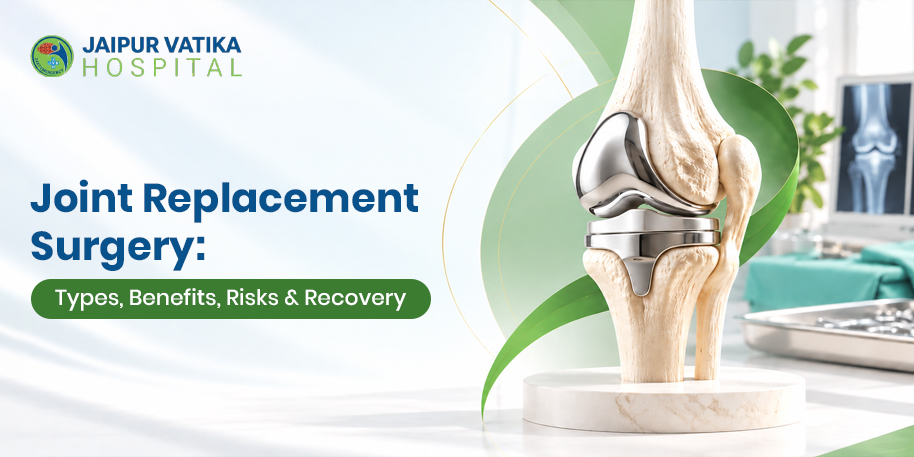
A joint replacement involves removal of the damaged surfaces of an affected joint and replacement with an artificial implant of metal, ceramic or plastic. It's primarily done on knees and hips. It is recommended for those who have pain after trying other treatments because of arthritis damage, making it hard to walk, climb stairs or get up from a chair.
Most patients who have hip replacements are age 50 to 80, although successful hip replacements have been performed at any age. A joint replacement is not the initial step. It follows medicines, exercise, weight management and walking aids that no longer help.
What Are The Primary Types Of Joint Replacement Surgery?
The Department of Orthopaedics at Jaipur Vatika Hospital (JVH) provides Total Knee Replacement (TKR) surgery and Total Hip Replacement (THR) surgery for patients experiencing severe Osteoarthritis (JVH Orthopedics). Let's take a look at the main differences between them:
| Type | What is replaced | Typical reason |
|---|---|---|
| Total knee replacement | Entire knee joint surfaces | Generalized arthritis of the knee. |
| Partial knee replacement | One damaged compartment | The injury to the knee is not extensive, only one portion. |
| Total hip replacement | A ball and socket joint of the hip. | Arthritis in the hip joint, damage to the bone caused by a fracture |
A hip implant has a metal or ceramic ball, a metal socket and a spacer between them. As the AAOS portrays, components are either cemented in place or press fit. Your surgeon will determine the design depending on your age, bone quality, activity level and damage as seen on X-ray.
What Are The Benefits of Joint Replacement Surgery?
AAOS reports that the majority of hip replacement patients see a dramatic decrease in pain and a marked improvement in the ability to do everyday activities (AAOS OrthoInfo).
The main benefits are:
- Less pain, including night time and rest pain.
- Improved walking, stairs and rising from chairs
- Independence, so you don't need walking aids and family support as much
- Improved sleep and mood due to consistent pain relief.Improved sleep and mood due to consistent pain relief.
Most knee replacements will last 15 to 20 years or longer (Mayo Clinic, Knee replacement). Those patients live a long time free of pain.
What we see in practice: Patients rarely regret having surgery. Most miss the chance to have waited for years in pain, their muscles atrophied, and the world shrunk. The earlier you assess the better, as you will have options like non-surgical.
Are There Any Risks Involved With Joint Replacement?
All operations involve risk and good care entails having an honest counsellor. According to Mayo Clinic, the primary concerns are blood clots, damage to nerves, infection and wear or loss of the implant. The infection rate following a hip replacement is less than 2% of patients per AAOS.
Other potential issues are:
- Stiffness or limited movement
- Leg-length difference after hip surgery
- Rarely seen, hip dislocation;
- Loosening of the implant over time (may require revision surgery)
These risks are minimised by the use of pre-surgery tests, blood thinners as necessary, sterile theatre practice and early walking by your surgeon. Report any diabetes, blood pressure, heart disease or medications you take to your doctor.
What is the Recovery Time for Joint Replacement Surgery?
Recovery starts the day of surgery. The operation takes 1 to 2 hours, and physical therapy starts immediately with early mobilization, according to Mayo Clinic. AAOS indicates that hips begin to feel better within 3-6 weeks of the surgery and that special precautions are required for the first 6 weeks.
A typical timeline:
- Day 0-2: Standing up and taking initial steps with a physiotherapist, pain control and blood clot prevention.
- Week 1-2: Utilize a walker or crutches. The stitches go away around week 2.
- Week 3 - 6: Start doing light daily tasks and begin to increase walking distance.
- Week 6: Strength, balance and stair confidence are developed. Your surgeon lets you return to more activity.
Each person's joint replacement journey is at a different speed and knee recovery may take longer than hip recovery. JVH has a physiotherapy clinic, which helps to create a personalized rehabilitation plan for your surgery. See our physiotherapy department.
Get your home ready for surgery: Clear away any loose rugs, install grab bars in the bathroom, make sure to have a bed on the ground floor (if possible), and ensure a raised toilet seat and a sturdy chair.
How to select an Orthopedic hospital in Jaipur?
Many people search for the best orthopedic hospital in Jaipur or the best orthopedic surgeon in Jaipur. These practical checks are for you to use; not all patients will fit into a single ranking.
- Is the surgeon an experienced knee and hip replacement surgeon?
- Is the same hospital the x-ray, lab, ICU and physiotherapy?
- Does the team have the ability to manage complications swiftly, at any time?
- Will you get a clear written rehab plan?
- Are there any cashless options available?
Jaipur Vatika Hospital is an orthopedic hospital located at Thikariya, Jaipur-Ajmer expressway with 24 hours emergency and trauma care, NABL accredited lab, digital X-ray and 24 hours pharmacy. It is the closest complete service for Bagru, Dudu and Phagi. Look at emergency and trauma services, and diagnostics and imaging.
At Jaipur Vatika Hospital, you can discuss with an orthopedic surgeon in Jaipur. Dr. Vijay Krishan Tiwari (MBBS, MS Orthopaedics) has 45 years experience. We have empanelled with SBI General, Aditya Birla and IFFCO Tokio and Universal Sompo for cashless treatment.
When is the Right Time for Joint Replacement ?
If you notice:
- Severe Pain in Joint while Walking
- Pain to the point of walking, stairs or dress restrictions.
- No relief from any medicine, physiotherapy or injections.
- Bowed legs, or other deformities seen at a glance
- Progressive stiffness that increases significantly.
Avoid the crisis approach. Planning a joint replacement before extreme joint damage and disability is safer than operating it during an emergency as stronger muscles will heal more quickly. For more information on conservative care, see our Orthopaedics department page.
Conclusion
The replacement of the joint can restore your stairs, walks, and good night's sleep. The key to the difference lies in a clear diagnosis, an honest conversation and a good rehab plan. Talk to our group of orthopaedic doctors if joint pain is hampering your life.
Please call to schedule your orthopaedic appointment today. Call +91-8209809753, or contact us online.
faq.faqs
faq.faqs-subheading
The Mayo Clinic states that most knee replacements will endure for at least 15-20 years. Lifespan is related to weight, level of activity, implant type and follow-up. Periodic check-ups allow for the early detection of signs of wear, which means that if the implant becomes loose, revision surgery is possible.
Stay is dependent on patient type and procedure. Many patients who have knee replacement surgery are discharged on a short notice, and sometimes, they are discharged on the same day, says Mayo Clinic. Your surgeon will determine this based on your pain control, mobility and medical conditions.
After surgery, there will be some pain that will be controlled by medication and getting moving. The arthritic joint typically gets better in weeks. The vast majority of patients report that it is much worse than the pain they experienced prior to surgery.
Weight loss, exercise, physiotherapy and medicines are often effective in the early stages of arthritis. When the above measures don't work, surgery is recommended. A review by an orthopaedic (bone) specialist determines your level and options.
Visit JVH website or avail JVH E-Consultation app or call on +91-8209809753. Walk-in to reception is welcome.