

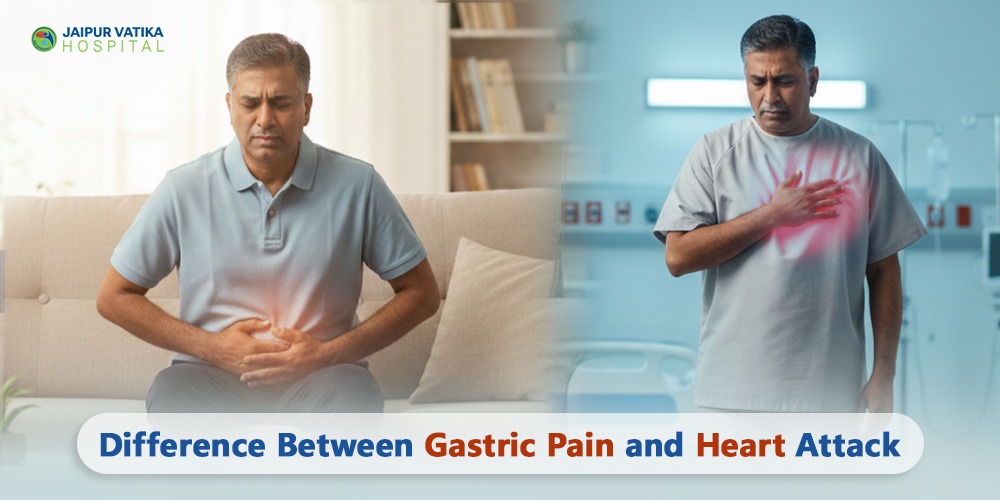
Health issues are usually ignored by people in the busy life of the capital of Rajasthan. This is seen frequently in the industrial and commercial area of the Ajmer road and Special Economic Zone (SEZ). But, considering persistent chest discomfort, one of the most risky information a person can obtain is that it is nothing more than a bit of gas.
Let’s examine the difference between gastric pain and heart attack along with both subtle and obvious symptoms of heart attack. We will also get an idea that to find out the best cardiology hospitals in Jaipur is as easy as typing simple terms like cardiology hospital near me or heart hospital in Jaipur near me.
How do I know if my chest pain is gastric or a heart attack?
The difference between the two lies in the character of the pain and also the response to movement or medication. The heart attack symptoms are usually heavy, crushing pain or squeeze in the middle or left part of the chest which does not go away even with antacids or rest. On the other hand, the difference in chest pain vs stomach pain is that the gas is usually sharp, is accompanied with bloating or belching, and is usually felt after a big meal or when the person lies down. When the pain extends to your jaw, back or left arm, this is a great warning sign of a heart attack.
Understanding Heart Attack Symptoms: The Signs You Can't Ignore
Myocardial infarction or heart attack occurs when blood supply to the heart muscle is blocked. The more time the blockage is present the greater the damage to the tissue of the heart.
Typical Signs of Heart Attack.
- Crushing Pressure: This has often been referred to as an elephant sitting on your chest.
- Radiation: The pain spreads to the neck, jaw, shoulders, or arms (limbs, in particular, the left arm).
- Cold Sweats: The sudden onset of excessive sweating which may not be as a result of any physical activity.
- Shortness of Breath: Breathless even at rest.
- Anxiety: A sudden feeling of looming imminent doom.
The Heart Attack Warning Silent.
The occurrence of cardiologists in 2026 is increasingly warning about the so-called silent attacks that are frequent in diabetic patients or the elderly. These do not necessarily include chest pains and instead come as intense, unidentifiable exhaustion, slight dizziness or a general lack of certainty. In the case of these high-risk categories, a heart hospital in Jaipur that has complex diagnostic equipment such as AI-based ECG triage is required to detect them at an early stage.
Gastric Pain and Heartburn
The most frequent mimics of chest pains related to the heart are gastric problems or Gastroesophageal Reflux Disease (GERD) and trapped gas.
Triggers and Symptoms
Etiology Meal: Pain in the stomach usually begins after ingesting spicy or oily food stuffs or after having a very big meal.
- Posture Dependency: The pain can be aggravated by bending over or lying on your back.
- Relief: When the pain disappears after belching, releasing gas, or taking a typical antacid, then it is probably due to digestive reasons.
- Burning Sensation: Heartburn is generally accompanied by a burning sensation which starts at the stomach and extends to the throat.
Gastritis That Feels Like a Heart Attack.
The diaphragm may be forced out by trapped gas, which may cause tightness in the lower chest. Likewise, the esophagus spasms also may cause severe pain that can hardly be distinguished as angina without the testing of a professional at an emergency hospital in Jaipur.
Heart Attack vs Gastric Pain: A Side-by-Side Comparison
| Feature | Heart Attack | Gastric Pain / Gas |
|---|---|---|
| Nature of Pain | Pressure, squeezing, heaviness | Sharp, burning, or cramp-like |
| Location | Center or left of the chest | Upper abdomen or behind breastbone |
| Radiation | Spreads to jaw, back, or arms | Usually localized; may move to shoulders |
| Associated Signs | Sweating, nausea, breathlessness | Belching, bloating, indigestion |
| Response to Antacids | No improvement | Usually improves significantly |
| Triggered By | Physical exertion or stress | Meals or lying down |
Non-Obvious Signs in Women and Young Adults
The more recent research (in 2026) discusses that women and the young adult (under 45) are likely to have unusual signs.
Women: More frequently complain of nausea, vomiting or sharp pain in the upper back or neck instead of crushing chest pain.
Young Adults: Milestones in heart disease in young Indians are increasing at a rapid pace and usually begin in young people as early as age 35 years because of a so-called CKM syndrome, which is a combination of heart and kidney-related health conditions with metabolic health.
In the case of these groups, they should be screened at an early stage in a best cardiology hospital Jaipur in case they possess risk factors such as high blood pressure or high cholesterol.
Finding a Hospital Near Me in Jaipur
In the Thikariya, Bagru or the Mahindra SEZ, the commute to the central city hospitals can prove fatal in the event of a cardiac emergency due to traffic jams.
Why Proximity Matters
The most crucial period in stabilizing the heart muscle is the first 60 minutes in an event of cardiac. There has been growth in Jaipur medical infrastructure which has resulted in specialization hubs such as Jaipur Vatika Hospital on Ajmer Road. These centers offer City-Level Treatment with Hometown Reach and the residents can intercept the emergency treatment before it goes out of control.
Updates for Cardiac Care in Jaipur
The cardiac care capacity in Jaipur is developing at a fast rate:- SMS Hospital Cardiac Tower: It is slated to come up in March 2026 and will provide 24/7 heart intervention at a world-class level.
- RAJ-SURAKSHA: Rajasthan government has suggested this new programme so as to accelerate access to emergency hospital services to heart attack and accidents through a 24/7 Critical Care Command Centre.
- Institute of Cardiology: It is proposed that a new institute will be established at the national level in Jaipur to offer special training and treatment.
How to Choose the Best Cardiology Hospital Jaipur
The following are desirable Pillars of Excellence when seeking a heart hospital in Jaipur:
- Senior Clinical Leadership: Find senior cardiologists. To illustrate, the 30 years of experience of Dr. Ram Chandra Ghasil (MBBS, MRCP-UK, FRCP-London), Jaipur Vatika Hospital, is a quality addition to the corridor along the Ajmer Road.
- 24/7 Diagnostic Preparedness: To ensure a diagnosis within minutes, the hospital is expected to have a diagnostic laboratory on site that is accredited by NABL and has advanced imaging (2D Echo, Digital X-ray).
- Advanced Trauma Support: To ensure that the emergency department utilizes the Advanced Trauma Life Support (ATLS) they should employ protocols to manage heart attacks as well as trauma caused by accidents.
- Cashless and Insurance services: Heart care is expensive. Hospitals with good reputation enable cashless treatment with other partners such as SBI General, Aditya Birla and IFFCO Tokio.
Emergency Steps: What to Do if You're Unsure
The health care policies of 2026 are simple: When you are uncertain, check it out.
- Call for Help: If you have a phone, call 108 or your local emergency phone number.
- Sit Still: Do not permit the individual to walk or drive himself.
- Chew Aspirin: When advised by the emergency personnel, and the patient has no allergies to it, chewing on a low dose aspirin can aid in the prevention of further clotting.
- Locate AED: Automated External Defibrillators have now been installed in many housing societies and offices within the SEZ location.
Conclusion
Even though gastric pain is an inconvenience, a heart attack is an emergency. In a developing city like Jaipur, there is no need to take any chances and expose yourself to the traffic in the city-centre to get high-authority medical care. Looking to have a preventative check-up by looking up cardiology hospital near me, or require emergency stabilizing care right now, make a choice in favor of such a facility that cares more about professionalism and its proximity to the place.
Making a gas problem a life-altering experience is wrong. It is important to listen to your body and understand your symptoms and have the phone numbers of a locally trusted heart hospital in Jaipur on your speed dial.
faq.faqs
faq.faqs-subheading
Yes. The gas trapping in the upper stomach can exert its pressure and tightness on the diaphragm resembling the pressure and tightness of a heart attack. Nevertheless, gas pain tends to vary with movement or passing wind, but the heart attack pain does not do so.
Women, just like men, complain of chest pains the most. They are however more likely to experience abnormal symptoms like sudden nausea, odd fatigue, or pain at the neck and jaw.
Yes. Ecg (Electrocardiogram) is available within minutes of any emergency hospital in Jaipur. These together with a blood test on Troponin give a final answer as to whether the heart muscle is suffering or not.
Majority of the private hospitals in Jaipur like Jaipur Vatika Hospital have tie-ups with major TPAs to give cashless treatment in case of cardiac emergencies.
Choosing a cardiac hospital in Jaipur near Thikariya, Mahapura, Bagru saves a lot of time on traveling. The most important aspect of a successful recovery is to be treated during the first hour of a heart attack.