

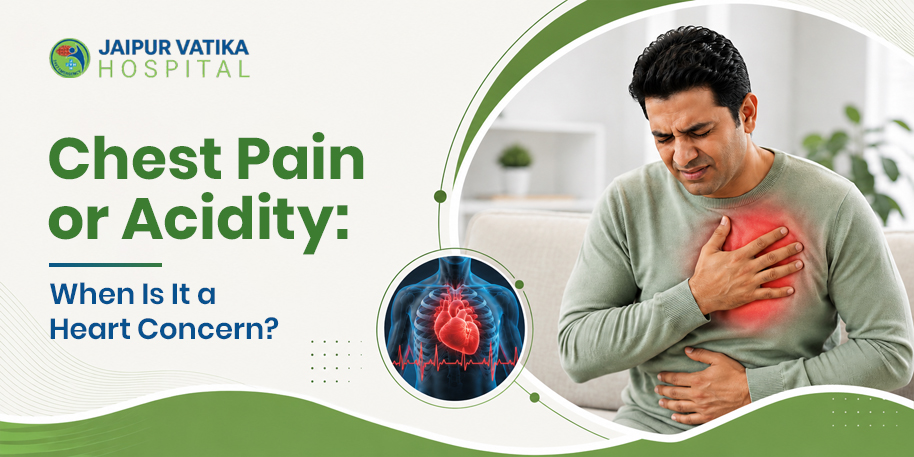
An unexpected, painful feeling in the middle of your chest. Could it be that spicy dinner two hours ago is in rebellion on your plate, or maybe it's your heart that is calling for assistance? Thousands of people each day end up in this very situation - is it chest pain or acidity? Severe indigestion (gastroesophageal reflux) and a heart attack can have very similar symptoms and descriptions, making it an easy mistake to mistakenly label a life-threatening cardiac event with the term 'heartburn'. One of the most common causes for people to put off seeking emergency medical care is because they are misled into thinking that their heart is distressed rather than their stomach. Every minute is of critical importance when the blood stops flowing to the heart muscle. When it comes to the difference between harmless indigestion and cardiac warnings and knowing where to get immediate chest pain treatment in Jaipur, it can really save a life. Let's discuss why patients experience similar symptoms of pain in both the heart and the stomach, how they can distinguish them, what symptoms they should seek immediate help at the emergency room, and how they can be evaluated by a trusted cardiologist in Jaipur.
Quick Takeaways
Shared Nerve Wiring:The nerves that supply your heart also supply your food pipe (esophagus), so it can be hard to tell the difference between the sensations of acid irritation and less blood flow to your heart.
Location and Triggers: The symptoms of acidity are burning sensations that increase upward towards the throat after eating, while pain in the heart is the sensation of heavy pressure, squeezing, or fullness that is aggravated by exercise or stress.
Watch for Numbness and Radiation: If you feel some discomfort in your left arm, shoulder, jaw, neck or upper back, watch for Radiation, which is a sign of a heart concern, not a simple acidity.
Don't take the "Antacid Test": Some heart attack symptoms improve briefly after taking antacids or soda or water – don't let this false sense of relief get in the way of emergency treatment.
The "Golden Hour" Saves Lives: If the chest discomfort lasts longer than 10-15 minutes and is accompanied by sweating, dizziness or shortness of breath, please visit immediately a heart hospital in Jaipur.
The Core Dilemma: How is acidity and heart pain similar?
To gain insight into how doctors take all chest pain seriously, it helps to know how your body feels pain in the inside organs.
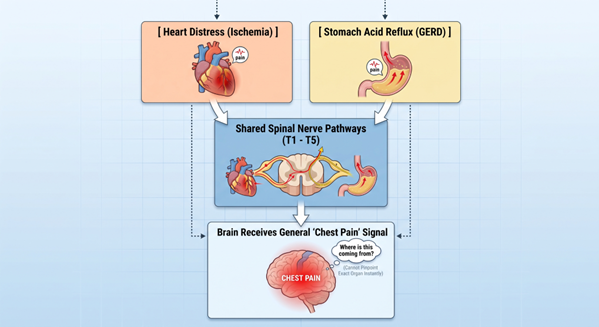
Referred Pain
Your internal organs do not have separate pain wiring as your skin does, which alerts you to every paper cut.
The heart is adjacent to your food pipe in your chest. They conduct their sensory signals to your brain via the exact same group of nerve clusters in your spinal cord.
Your brain interprets the signal from these nerves as one of stress, difficulty with distinguishing if the message is from acid in the stomach irritating the esophagus or from the heart muscle losing oxygen. That's because this biological similarity makes it easy to mistake acidity with chest pain.
Knowing the difference between Heart Attack and Acidity symptoms can help you get the right diagnosis and treatment for your condition.
Both conditions can lead to chest discomfort, but have completely different triggers, physical sensation, and symptoms.
Comparing the Two Types of Pain
| Burning sensation in the chest or throat | Heavy pressure, tightness, squeezing, or crushing sensation |
| May move upward toward the throat | May radiate to the left arm, jaw, neck, or back |
| Often occurs after a heavy or spicy meal | May occur while walking, climbing stairs, or during sudden stress |
| May improve when sitting upright or taking antacids | May be accompanied by nausea or breathlessness |
1. The quality of the pain.
Acidity:It is generally described as a hot, fiery or burning sensation behind the breastbone. One might experience a sour or bitter taste in the back of the throat or swallowing problems, or food may come back up.
Heart Concern: If you have heart pain, you don't put it down to "burning". Instead, they report extreme squeezing, weight (such as an elephant sitting on the chest), fullness or a feeling of ache around the ribs.
2. Radiating Pain
sensation: This is associated with acidity and runs straight up from the upper belly up to the lower throat. Very rarely spreads to arms or jaw.
Heart Concern: Pain from the heart often radiates into the back. It will often spread into the left arm, both shoulders, neck, jaw, teeth or between the shoulder blades.
3. What causes the pain?
Acidity – pain begins within the first 30 to 60 minutes after eating a spicy, fried or heavy meal or bending over or lying flat on your back shortly after food.
Heart Concern: The discomfort may be caused by physical exertion (e.g., climbing stairs, walking up hill, carrying groceries) or an acute emotional stress. This occurs because your heart requires more oxygen when you are exercising, but the blocked arteries can no longer supply the blood to your heart.
4. What Gives Relief?
Acidity:Cold water, sitting up straight or chewing an over-the-counter antacid typically will soothe the burning in 10-15 minutes.
Heart Concern: If your symptoms of angina subside on their own, with water, antacids and rest, it is not a heart attack.
What is the difference between Heart Attack vs Acidity symptoms?
| Feature | Acid Reflux / Indigestion | Heart Attack / Angina |
|---|---|---|
| Type of Sensation | Sharp, burning, hot, acidic | Dull, heavy pressure, squeezing, crushing tightness |
| Location | Behind breastbone, rising toward throat | Center or left side of chest |
| Radiation | Stays localized in chest and throat | Spreads to left arm, shoulder, jaw, neck, or back |
| Common Trigger | Spicy meals, lying down after eating | Physical exertion, walking uphill, cold air, stress |
| Associated Signs | Belching, sour burps, bloating | Cold sweats, breathlessness, dizziness, nausea |
| Response to Antacids | Usually relieves symptoms quickly | Little to no lasting relief |
| Urgency | Low to moderate (Consult doctor if chronic) | Critical Emergency. Call for an ambulance |
The American Heart Association (AHA) provides valuable resources that provide an in-depth analysis of each of these clinical cues to look out for for heart distress.
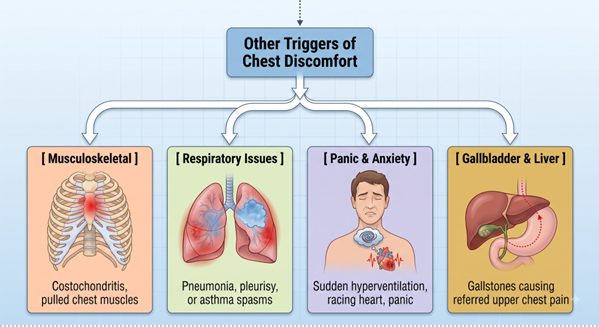
Other causes of chest pain include:
When To Call For Immediate Emergency Care
DO NOT wait for chest pain. Stop and get immediate attention at a heart specialist hospital in Jaipur if you or someone around you shows signs of any of these:
Is Your Chest Pain An Emergency?
| Care Level | Symptoms / Signs | Recommended Action |
|---|---|---|
| Mild Acidity Profile | Mild burning sensation after a spicy meal, relieved by an antacid, with no sweating | Monitor symptoms, adjust your diet, and consult a physician if symptoms occur frequently. |
| Cardiac Warning Signs | Heavy chest squeezing, pain spreading to the jaw or arm, breathlessness, or cold sweats | Call for a 24/7 Advanced Life Support, ALS, emergency ambulance immediately. |
Critical Danger Signs
- Very strong, heavy pressure in the chest that stays for more than 10 minutes.
- Left arm, neck, jaw, back, or abdomen pain.
- Sudden onset of cold sweats (breaking out in a sweat without heat or exertion).
- If they have shortness of breath or gasping for breath when they sleep, without an explanation.
- Sudden lightheadedness, dizziness or fainting.
- Nausea or sudden vomiting, or a sense of impending death.
Special Warning For Women, Senior Citizens And Diabetics.
Not all heart attacks are accompanied by "the picture perfect" chest-clutching. Medical research presented by the National Institutes of Health (NIH) shows that women, elderly individuals and individuals with a history of long-term diabetes have different symptoms when experiencing heart attack:
- They do not necessarily have a severe chest pain, but only very tired, mild breathlessness, nausea, tightness in the back or stomach discomfort.
- Diabetic patients, for example, can have nerves damaged (diabetic neuropathy) that dulls pain messages making what is actually a heart attack "silent.
- Do not mistake sudden chest pain as acidity if you are diabetic, have hypertension or hyperlipidemia.
What to Do Immediately If You Suspect a Heart Issue
If you believe that your chest pain is heart-related, take the following important steps:
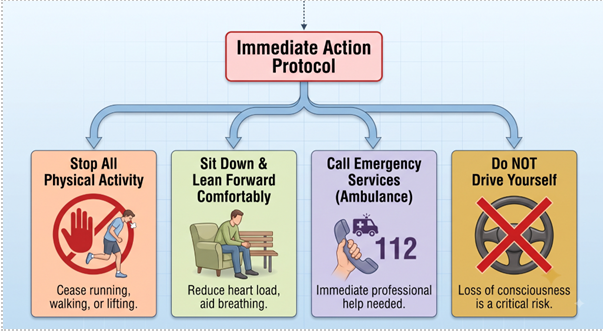
This activity involves going forward with a sense of comfort; often using services such as an ambulance.
STOP – If you're still doing something, SIT down immediately. Avoid walking it off, or completing tasks. When the body is partially upright, the heart is not under mechanical stress.
Call an Emergency Ambulance: Call a hospital with Advanced Life Support (ALS) ambulance. Paramedics trained to administer oxygen are able to initiate treatment to save lives, make an ECG reading on the spot and begin stabilization before you ever arrive at the hospital.
Don't Drive Yourself:Don't try to drive yourself or a two-wheeler to the hospital while having chest pain. When driving and you lose consciousness you put yourself and others in great danger.
How Doctors will Find the Exact Cause of Your Chest Pain.
If you have chest pain when you reach the emergency room or a cardiology clinic, doctors have a quick, systematic process for finding out what is causing chest pain within minutes.
The Rapid Diagnostic Protocol
| Emergency Cardiac Rule-Out | Comprehensive Follow-Up |
|---|---|
| 12-Lead ECG / EKG | 2D Echocardiography, Echo |
| Cardiac Blood Biomarkers, Troponin I/T | Treadmill Stress Test, TMT |
| Blood Pressure & Pulse Oximetry |
12-Lead Electrocardiogram (ECG): This is the first and most important test. Small sensors installed on the chest immediately capture the heart's electrical pattern, indicating whether an artery is blocked or if the heart muscle is strained, after just 5-10 minutes of arrival.
Cardiac Enzyme Blood Tests (Troponin I / Troponin T): Damage to the heart muscle cells is caused by an inadequate supply of blood and these cells release certain proteins (troponins) into your bloodstream. Even the smallest heart damage can be confirmed in hours by a quick blood test.
2D Echocardiography (Echo): Ultrasound imaging of your heart that provides real-time images of your heart valves, chamber size and how well your heart walls pump blood.
If the tests of the heart are all completely normal, and the acidity continues, a gastroenterologist might look inside your food pipe and stomach with a gentle camera to see if you have acid ulcers, gastritis or GERD.
These are important tests that can be conducted immediately after arrival in a hospital with its own ECG and the diagnostic laboratory, so that there are no delays in the diagnosis.
An Expert Care: Cardiologist and Heart Hospital in Jaipur is always here.
If that happens, the need of the hour is the availability of fast and reliable medical facilities, which can provide you assistance for all the issues ranging from acute heart attacks to chronic acid reflux. With expert advice from a top cardiologist in Jaipur, your heart's health is assessed accurately and sympathetically.
These essential features should be taken into account when selecting a medical facility for cardiac treatment:
24/7 Rapid Emergency & Golden Hour Support: 24/7 access to emergency and trauma care with Advanced Life Support (ALS) ambulances with capacity to deal with acute cardiac emergencies along the Jaipur – Ajmer Expressway and within the city limits.
Complete Non-Invasive Cardiac Diagnostics: 24/7 access to digital ECG, 2D Echo, color Doppler and cardiac biomarker testing.
Integrated Internal Medicine & Gastroenterology: When you have general physicians, cardiologists and digestive health specialists working together, your cardiac or digestive health problem receives accurate treatment.
Telemedicine & Follow-Up Convenience: For routine follow-ups, medication adjustments, or lifestyle guidance, the JVH E-Consultation App enables patients to connect directly with doctors from home.
There are centers like Jaipur Vatika Hospital that offer such a 360-degree continuum of care, with ready availability, advanced cardiac diagnosis and a team of internal medicine experts to protect your health.
Conclusion
The body's most critical warning system is chest pain. Acidity or indigestion is very common in everyday life and to think that a problem with the chest is "just gas" can have serious repercussions if it is actually cardiac related. Keep in mind the rule of thumb when it comes to chest pain If in any doubt, seek a heart check first. A few minutes will provide peace of mind and you will receive the proper treatment when you need it if you get an ECG at a reputable heart specialist hospital in Jaipur.
Do Not Take Chances with Chest Pain
Seek immediate medical help if anyone or a family member are having sudden chest tightness, burning or breathlessness. Visit the Jaipur Vatika Hospital for 24×7 emergency support, immediate cardiac diagnosis and expert consultation or consult with the medical team via the JVH E-Consultation App today.
faq.faqs
faq.faqs-subheading
At home, no one can be 100% sure just from their feelings. Since a heart attack often resembles a mild case of indigestion and indigestion, in turn, can look like a heart attack, a 12-lead ECG is the only sure way to know your heart is OK, and it can be done quickly, at a medical center.
Acid reflux usually makes the throat feel burning and moves up the esophagus toward the throat, but occasionally, severe esophageal spasms can make the throat feel burning, and spread toward the back. If the pain radiates to the left shoulder, left arm or jaw, however, it's a sure sign of a cardiac issue and should not be attributed to acidity.
Water being belched or sipped will temporarily alter the pressure inside your chest, which will stimulate the vagus nerve and temporarily alter your feeling of discomfort. Many patients think that if they burped and got a little better, it was just "gas". Avoid the false relief and delay in emergency evaluation.
Angina is pain in the chest that comes and goes when the heart muscle is not getting enough blood and oxygen (usually when exercising or under stress), and typically clears up with rest. A heart attack is a condition where an artery becomes totally blocked and the heart muscle is injured permanently unless the artery is opened right away.
Cardiologist in Jaipur should be seen if the chest tightness occurs during walking or climbing stairs repeatedly, if there is no known cause of shortness of breath, if there are rapid heartbeats that do not seem to have any cause or if somebody has other heart disease risk factors, such as diabetes, smoking, high blood pressure or a family history of early heart disease.